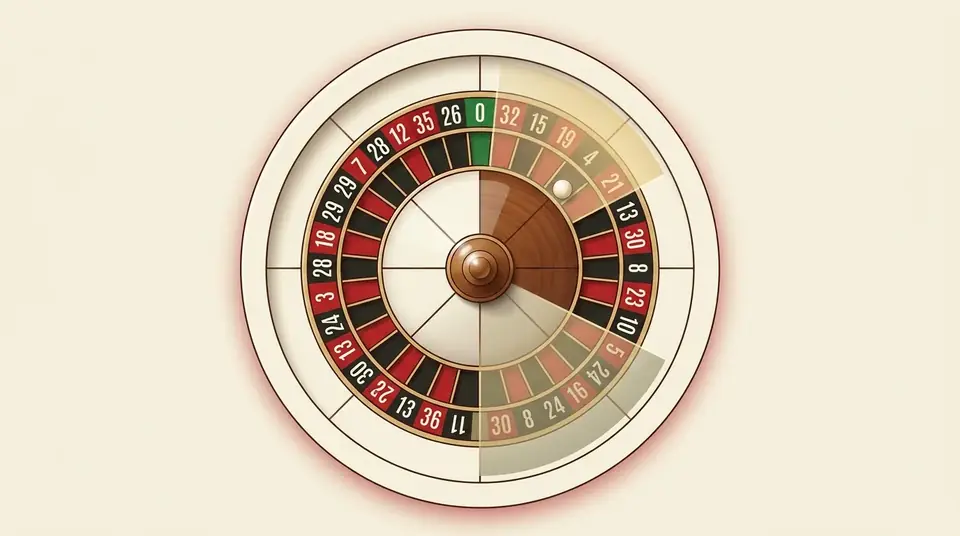
European Roulette Wheel Sequence
The European single-zero wheel uses the following clockwise sequence, starting from zero:
Read it as a loop - after 26 you are back to 0. The order looks random at first glance, but it follows three design principles:
- Reds and blacks alternate as much as possible
- Low (1-18) and high (19-36) numbers are spread evenly around the wheel
- Consecutive numbers like 1 and 2 are placed on opposite sides
Wheel Layout vs Table Layout
The roulette table and the roulette wheel are two different objects with two different jobs.
- The table is built for bet placement. Numbers 1 to 36 sit in three columns of twelve, with the zero at the top. Inside bets cover squares of 1, 2, 3, 4 or 6 adjacent numbers on the grid.
- The wheel is built for fair distribution. Numbers are arranged so that colour, parity and high/low alternate around the rim.
A "split" bet on the table joins two physically adjacent grid squares (for example 1 and 2). On the wheel, 1 and 2 are nowhere near each other. That mismatch is the entire reason sector and neighbours bets exist.
European Wheel Sectors
The wheel is divided into four named sectors that French roulette uses for call bets:
17 numbers around zero. Covers from 22 to 25 on the wheel, including the zero itself.
12 numbers on the opposite side of the wheel from zero. Runs from 27 to 33 on the wheel.
8 numbers that are not part of Voisins or Tiers. Split into two short arcs.
A smaller subset focused on zero. 7 numbers: 12, 35, 3, 26, 0, 32, 15.
These sectors only make sense on the wheel. They are useful shorthand for placing several chips at once, but they do not predict where the ball will land.
How Table Bets Connect to the Wheel
How bets relate to the physical wheel:
- Straight up covers one pocket. Same on wheel and table.
- Split, street, corner, six line are table groupings. They cover numbers that are next to each other on the printed grid, not on the wheel.
- Neighbours bet is a wheel grouping. You pick a number plus a chosen count of pockets on each side of it.
- Sector bets (Voisins, Tiers, Orphelins, Jeu Zero) are wheel groupings.
Best Practical Use of the Wheel Sheet
The wheel sheet is most useful for two practical reasons:
- Placing sector bets quickly. Knowing the wheel order lets you read what a Voisins or Tiers bet actually covers.
- Understanding neighbours bets when a dealer calls them.
It is not useful for predicting outcomes. Random spins on a properly maintained wheel do not "favour" any sector over time. Every pocket has a 1 in 37 probability on every spin.
For the raw pocket order alone, see the roulette wheel sequence page. For the sector map with exact numbers in Voisins, Tiers, Orphelins and Jeu Zéro, see the roulette wheel sectors reference. And for the felt grid on the other side of the table, see the roulette table layout.
Responsible gambling note: Roulette is a negative expectation game. Cheat sheets and strategy guides help you understand bets, payouts and risk, but no system removes the house edge. Only play with money you can afford to lose, and stop when play stops feeling controlled.
Related Guides
For odds, payouts, wheel layouts and betting systems across every variant, return to the main roulette cheat sheet.