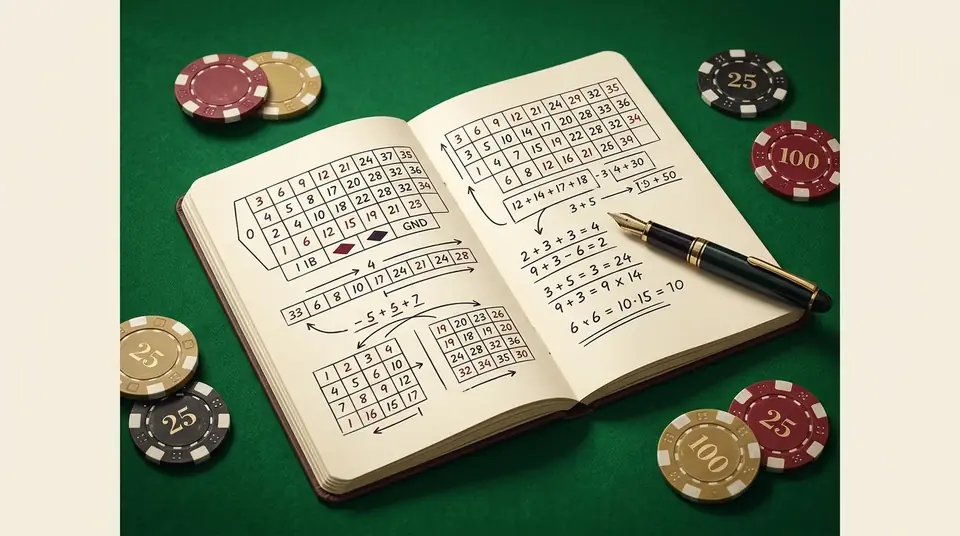
Cheat Sheet Summary
| System type | Negative progression (cancellation) |
|---|---|
| Best suited table | European or French roulette |
| Usual bet type | Even-money bets |
| Risk level | High - sequence can extend rapidly |
| Bankroll pressure | High during losing streaks |
| Changes house edge? | No. The Labouchere system does not change the underlying odds. |
Pick a target profit (e.g. 10 units), split it into a starting sequence (e.g. 1-2-3-4). Each round, bet the first plus the last number. On a win, cross them off. On a loss, add the lost amount to the end. Stop when the sequence is empty.
How the System Works
- Decide your target profit and split it into a sequence of numbers.
- Bet (first + last) on an even-money chance.
- On a win, cross off the first and last numbers.
- On a loss, append the lost stake to the end of the sequence.
- Repeat until all numbers are crossed off.
Example Betting Sequence
Starting sequence: 1-2-3-4. Target: 10 units.
| Step | Sequence | Bet | Result |
|---|---|---|---|
| 1 | 1-2-3-4 | 5 | Loss → append 5 |
| 2 | 1-2-3-4-5 | 6 | Win → cross off 1 and 5 |
| 3 | 2-3-4 | 6 | Win → cross off 2 and 4 |
| 4 | 3 | 3 | Win → cross off 3 |
Sequence empty. Target hit.
What the System Tries to Do
The cancellation logic rewards two wins for every loss because each win cancels two numbers and each loss adds only one. In theory, hitting roughly half your bets clears the sequence. In practice, losing streaks extend the sequence faster than wins shrink it.
Where the Risk Appears
The danger is a long stretch of losses early in the cycle. Each loss adds a larger number to the end of the sequence, which then becomes the next loss to recover. The bet size grows much faster than D'Alembert and can rival Martingale in bad runs.
Many players abandon mid-cycle with a sequence longer than they started with - locking in a real loss for what was supposed to be a small target.
Responsible gambling note: Roulette is a negative expectation game. Cheat sheets and strategy guides help you understand bets, payouts and risk, but no system removes the house edge. Only play with money you can afford to lose, and stop when play stops feeling controlled.
Best Bets to Use With This System
Even-money outside bets. The win/loss math of the cancellation logic assumes 1:1 payouts.
When to Stop
- Stop when the sequence is cleared (target hit).
- Stop at a hard limit on sequence length (for example, never let it exceed 8 numbers).
- Stop at a strict bankroll loss limit.
If session limits start slipping, step away. See our safe gambling guide for budget tools, time limits and warning signs.
Final Practical Verdict
Labouchere is flexible - you choose the target and the starting sequence - but the cancellation mechanic punishes losing streaks badly. It rewards discipline and a hard sequence-length cap.
Related Strategies
Browse the full roulette strategy hub for every betting system on this site, or compare with a related system below.
For odds, payouts, wheel layouts and betting systems across every variant, return to the central roulette cheat sheet.