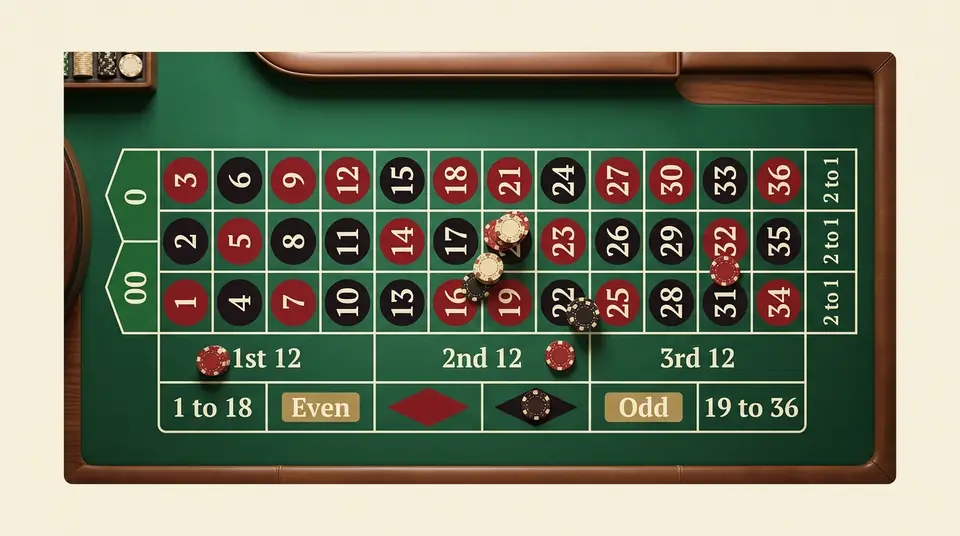
What Is the Roulette Table Layout?
The roulette table layout is the felt betting surface where chips are placed. It is a grid of numbers 1 to 36 arranged in three columns of twelve, with the zero (and the double zero on American tables) sitting at the top. Every roulette bet type - inside or outside - has a specific area on that grid.
This page walks through the layout section by section, shows how European, American and French tables differ, and clarifies why the table grid is not the same thing as the physical wheel.
Inside Betting Area
The inside area is the number grid itself. Five bet types live here:
- Straight up: place the chip directly on a number. Covers 1 pocket. Pays 35:1.
- Split: place on the line between two adjacent numbers. Covers 2 pockets. Pays 17:1.
- Street: place on the outer edge of a row of three. Covers 3 pockets. Pays 11:1.
- Corner: place at the intersection of four numbers. Covers 4 pockets. Pays 8:1.
- Six line: place on the outer edge between two rows. Covers 6 pockets. Pays 5:1.
Chip position is precise. A chip half on and half off a line is usually treated as the more specific bet by the dealer, so placement matters.
Outside Betting Area
The outside area wraps around the number grid. Five bet types live here:
- Red / Black: single box each. Covers 18 pockets. Pays 1:1.
- Odd / Even: single box each. Covers 18 pockets. Pays 1:1.
- High (19-36) / Low (1-18): single box each. Covers 18 pockets. Pays 1:1.
- Dozen (1st 12, 2nd 12, 3rd 12): single box each. Covers 12 pockets. Pays 2:1.
- Column: the "2 to 1" box at the bottom of each column. Covers 12 pockets. Pays 2:1.
Outside bets hit more often, pay less and are easier to place - a good place to start if you are new to the game.
European Roulette Table Layout
European roulette tables have a single zero space at the top of the grid, above the "1, 2, 3" row. Everything else is the standard three-column, twelve-row layout with the outside boxes around it.
Because there is only one zero, the outside bets on European tables cover 18 of 37 pockets. That is the cleanest baseline you'll find on a payout chart.
American Roulette Table Layout
American roulette tables add a 00 space next to the 0 space, giving two green pockets on the felt. Everything else looks the same, but the outside bets now cover 18 of 38 pockets and the house edge doubles from 2.70% to 5.26%.
The five-number bet (0, 00, 1, 2, 3) only exists on American tables. It carries a 7.89% house edge, which is worse than every other bet on the layout.
French Roulette Table Layout
French roulette uses the same single-zero table structure as European, but every box is labelled in French:
- Rouge / Noir - Red / Black
- Pair / Impair - Even / Odd
- Manque (1-18) / Passe (19-36) - Low / High
- Douzaines (P12 / M12 / D12) - Dozens (1st / 2nd / 3rd)
- Colonnes - Columns
Many French tables also print a racetrack panel next to the main grid for call bets like Voisins du Zéro. La Partage or En Prison rules apply to even-money bets when 0 lands, subject to the table sign.
Roulette Table Layout vs Wheel Layout
The felt tells you where to place chips. The wheel tells you which pocket resolves the spin. They are related, but they are not organised the same way.
- On the table, 1 and 2 sit next to each other - a "split" bet covers them.
- On the wheel, 1 and 2 sit on opposite sides of the rim - a physical "neighbour" bet would never cover both.
Sector and neighbours bets always follow the wheel. Splits, streets, corners, dozens and columns always follow the table. For the wheel side, see the roulette wheel sequence and the European wheel layout.
Download the Roulette Table Layout Sheet
The printable roulette table layout sheet shows the full betting grid with inside and outside areas labelled, the American 00 space marked separately and a small French-term translation panel. Bring it with you the first few times you play at a French table.
Download Roulette Table Layout PDF
For payouts on each of these areas, see the roulette payout chart.
Common Mistakes
- Confusing table layout with wheel order. Two totally different arrangements of the same 37 or 38 numbers.
- Placing a split/corner/street incorrectly. A chip 2mm inside a box is that box; a chip on the line covers both. Precision matters.
- Not noticing 00 on American tables. Some players forget the extra pocket and think their odds are the same as European.
- Misunderstanding French table terms. Manque means "low" (1-18), Passe means "high" (19-36). Impair means "odd", Pair means "even".
- Treating table layout as a prediction system. No arrangement of the felt predicts the ball. The grid is for placement, not forecasting.
Responsible gambling note: Roulette is a negative expectation game. Cheat sheets and strategy guides help you understand bets, payouts and risk, but no system removes the house edge. Only play with money you can afford to lose, and stop when play stops feeling controlled.
For odds, payouts, wheel layouts and betting systems across every variant, return to the main roulette odds and payouts reference.