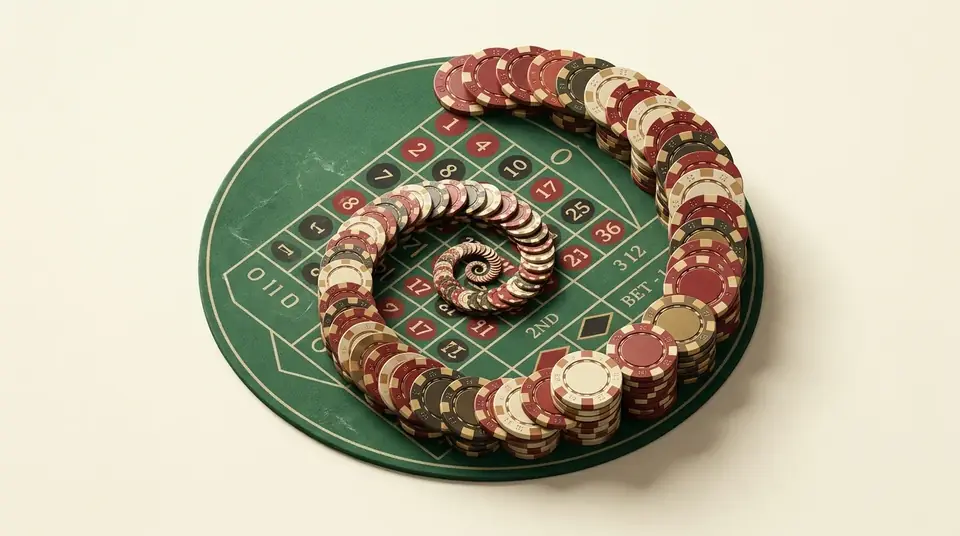
Cheat Sheet Summary
| System type | Negative progression (sequence-based) |
|---|---|
| Best suited table | European or French roulette |
| Usual bet type | Even-money bets |
| Risk level | Medium-high |
| Bankroll pressure | Moderate; grows faster than D'Alembert, slower than Martingale |
| Changes house edge? | No. The Fibonacci system does not change the underlying odds. |
Move forward one step in the Fibonacci sequence (1, 1, 2, 3, 5, 8, 13, 21...) after each loss. After a win, move back two steps in the sequence.
How the System Works
- Set the base unit and pick an even-money bet.
- Start at the first number (1).
- After a loss, advance one position in the sequence and bet that number of units.
- After a win, step back two positions (or back to the start if there are fewer than two positions behind you).
- End the session when the sequence returns to position 1, or at a preset stop.
Example Betting Sequence
| Spin | Position | Bet | Result | Running P/L |
|---|---|---|---|---|
| 1 | 1 | 1 | Loss | -1 |
| 2 | 2 | 1 | Loss | -2 |
| 3 | 3 | 2 | Loss | -4 |
| 4 | 4 | 3 | Loss | -7 |
| 5 | 5 | 5 | Win | -2 |
| 6 | 3 | 2 | Win | 0 |
What the System Tries to Do
Fibonacci tries to recover most of a losing streak through a structured progression that grows slower than doubling. Two wins are usually enough to return the position counter near the start.
Where the Risk Appears
A bad streak still grows the bet quickly. Eight losses in a row push the bet to 21 units and the cumulative loss to 54 units. The recovery requires several consecutive wins, which is exactly what the streak just showed is not guaranteed.
The system can also leave the sequence stuck in the middle for long stretches, slowly grinding the bankroll down.
Responsible gambling note: Roulette is a negative expectation game. Cheat sheets and strategy guides help you understand bets, payouts and risk, but no system removes the house edge. Only play with money you can afford to lose, and stop when play stops feeling controlled.
Best Bets to Use With This System
Even-money outside bets only. The progression mechanic depends on 1:1 payouts.
When to Stop
- Stop when the sequence reaches position 1 with a session profit.
- Stop at a hard sequence position cap (for example, never go beyond position 8).
- Stop at a strict bankroll loss limit.
If session limits start slipping, step away. See our safe gambling guide for budget tools, time limits and warning signs.
Final Practical Verdict
Fibonacci is more structured than Martingale and slightly more aggressive than D'Alembert. It feels methodical but offers no real edge improvement. Useful as a session framework, not as a winning system.
Related Strategies
Browse the full roulette strategy hub for every betting system on this site, or compare with a related system below.
For odds, payouts, wheel layouts and betting systems across every variant, return to the roulette cheat sheet homepage.